I am always rewarded for bringing my sailing gear with me when I travel between school and home. Maybe that's why I continue to add it to my packing pile, even when I am only going to be home for a few short weeks.
I was rewarded yet again this week, when I got the usual text message: "Can you sail tomorrow night?" After working out a few kinks in my schedule, I sent back my favorite reply: "I'll be there!"
I am at the sweet point where I don't need to ask who, what, when, or where. It's Mr. Rich's J/24, 5:30 PM, at the yacht club. Who else? That question has a different answer every week, which is part of the fun. This week, Mr. Rich represented the upper end of the crew's age range, and 3 of the 4 other crew members were within a year of my age. At other times, I've been the youngest by far. It's always fun, and I always learn something, no matter who I sail with.
I've sailed on boats where I get to do a little more than I do on this particular boat, but sailing is not always about pushing the limits of my ability. Sometimes it's about enjoying my comfort zone.
Last night was a particularly good night. There was the fact that I wasn't sure if I could go, and then the surprise when it turned out I could make it. Then there was the fact that Thursday dawned about ten degrees cooler than Wednesday had, not to mention about 10 knots breezier and 10 units of haziness less hazy. That breeze stuck around all day, putting ideas into my head about how it might, just might, stick around for evening racing. Those ideas strengthened as I drove over the Bay Bridge and saw the white-capped water and felt my car buffeted by the still-steady wind. It looked windy enough to plant that little seed of anxiety in my head. Or is it stomach? Wherever it is exactly that it gets planted, it makes me that much happier when I go sailing anyway and have a great time anyway.
What else? A warm welcome from friends I haven't seen in many months. Just warm enough sun and just cool enough breeze. The overpowering scent of Water Babies sunscreen. Getting a face-full of spray and thinking, Good thing I brought dry clothes to drive home in, rather than, I knew I should have brought dry clothes to drive home in. Hearing my friend say to me, under her breath, "You know, I'm more of a 10-12 knot kind of girl," rather than, "I love it when it blows 20 knots!" Because when I say "Me, too," I can mean it wholeheartedly rather than halfheartedly. Funny how the first statement squelches that seed of anxiety, while the second doesn't do anything for it either way.
Finally, the cherry on top: We're two-thirds, or maybe even three-quarters up the last beat of the second race. There's one boat to leeward of us. They tack, and we lee-bow them. I feel like I can reach out and touch their jib, we're so close. I am sitting on the rail between two friends, all three of us hiking as hard as we can, thinking heavy thoughts, but that boat is eating shoreline on us. Those heavy thoughts start to feel like they really are making my toes heavier, and then we are even, and then we are pulling ahead, and then we are bow-out and shutting the door on them. We put the bow down and we're in the groove, and we cross the line in first.
We do one more race, and then we sail back to the basin. This is the kind of sailing where re-action is sufficient, unlike racing, which demands pro-action. Back on shore, I'm to another sweet point; I hardly ever have to ask What next? Where does this go? or Is this the way?
The boat put away, our boating party breaks up. I walk to my car with the best memento I can take home from Thursday night sailboat racing: an invitation to come sailing again next week.
Friday, June 3, 2011

Spring at last!

What month does that photo look like to you?
March? Maybe April?
I took that photo on May 12.
I believe I was already writing wishfully about spring back in February, but it really took until May for spring to really, truly be here. Look, even in that photo there are only a few trees that are green. There were dairy farms that, as of May 25, had not planted corn yet, because it hasn't been dry enough to get tractors into fields.

To be fair, our Northern Spring has a lot to overcome. The same old principles of inertia and momentum still apply: an object at rest tends to stay at rest; an object in motion tends to stay in motion. In this case, a season at rest tends to stay at rest. Spring must overcome the inertia of a winter that has been peacefully at rest in the region for at least four and a half months. The sun must warm a ground that has been frozen. It must coax plants into growth that have been living efficiently on stored energy. "Why should we photosynthesize?" they must grumble, "We have plenty of sap."
But grow they do, to the relief of everyone.

Cows included.
Thursday, February 24, 2011
Things Winston eats
One of my housemates returned to school last August with a canine companion named Winston. He's a miniature Schnauzer, and is now about 10 months old. Even at such a tender age, he has already compiled a long list of "dietary indiscretions," also known as "stuff he shouldn't have eaten." This list is just to get us going. I fully expect this to become a regularly-appearing topic.
Chocolate (including Hershey kisses, a raspberry-filled Gertrude Hawk dark chocolate bar from the box I'm supposed to be selling for a fundraiser, mini Reese's cups, M&Ms, and peanut M&Ms)
Twizzlers
Jolly Ranchers
An entire, unopened pack of chewing gum
Used tissues, straight from the trashcan
An entire bag of kitty treats
Ibuprofen (more than once)
A tube of hydrocortisone anti-itch cream
PPA, a drug used to treat canine urinary incontinence
So much dry cat food in one sitting that he vomited intact cat food kibbles overnight, and was pooping intact cat food kibbles the next morning. Basically his entire GI tract was full of cat food.
The tasty treats the cats hide in their litter boxes...yes...you know what I mean.
So, that's all I can think of off the top of my head.
Chocolate (including Hershey kisses, a raspberry-filled Gertrude Hawk dark chocolate bar from the box I'm supposed to be selling for a fundraiser, mini Reese's cups, M&Ms, and peanut M&Ms)
Twizzlers
Jolly Ranchers
An entire, unopened pack of chewing gum
Used tissues, straight from the trashcan
An entire bag of kitty treats
Ibuprofen (more than once)
A tube of hydrocortisone anti-itch cream
PPA, a drug used to treat canine urinary incontinence
So much dry cat food in one sitting that he vomited intact cat food kibbles overnight, and was pooping intact cat food kibbles the next morning. Basically his entire GI tract was full of cat food.
The tasty treats the cats hide in their litter boxes...yes...you know what I mean.
So, that's all I can think of off the top of my head.
Tuesday, February 22, 2011
How to vaccinate 100 llamas in one day
Send in 20 vet students!
A few weeks ago, this email appeared in my inbox:

Seeing as how I have zero experience working with llamas, naturally, I signed up.
It turned out that most of the llamas were geldings, so we knew ahead of time that we probably weren't going to be doing any preg checks, but that was just about all we knew going into the day. When we arrived at the farm, the owner showed us around, and then explained his plan: one by one, send each llama into a squeeze chute, vaccinate it, scan it for a microchip (just like the ones to reunite lost pets with their owners), and take its photo for his website.
A low hum, similar to the sound made by a swarm of angry hornets, filled the barn: twenty vet students, who had just driven 2 and a half hours to get some hands-on llama wrangling experience, did the math, and immediately figured that 3 vaccines, a photo, and scanning for a microchip meant approximately 5 people would be occupied at any given moment, while the rest of us stood around and watched.
A few tentative hands went up, and with them, a few tactful inquiries were made.
"Dr. Smith, is there anything we can do with the llamas while they are still in the pen, before they go to the chute?"
"It seems like putting each llama through the chute might take a very long time."
"Maybe we can put the first one in the chute, just to demonstrate everything we're going to be doing."
After the first llama was secured in the chute, vaccinated, scanned, and photographed, the farm owner had a brilliant idea: "Maybe," he mused aloud, "if the students work in teams....they'll be able to do the vaccines in the pens, and we'll use the chute just for photos and microchip scanning."
So, that is what we did. There was a big open pen toward the back of the barn, and four or five smaller pens or stalls near the front. Other volunteers (local llama enthusiasts) sent groups of llamas out of the big pen, and we herded them into the stalls. Then we got to work. A pair of students started drawing up vaccines, and I joined up with some of my friends to start wrestling llamas.
It was harder than we suspected. Llamas are not huge creatures, not compared to horses and dairy cows, but they are strong. They fling their necks around, rear up, and strike with their hind legs. They are also agile--on more than one occasion, a llama, standing at the gate to a pen that was at least at their eye-level, would get the notion that life outside the pen looked a lot more promising than life inside the pen, where it's brethren were systematically being chased around, poked, and prodded. So it would do what any llama would do: take a deep breath, and attempt to jump straight up and over the gate. Many were successful; including one that jumped over the gate I was guarding to prevent just such an occurrence.
Two of the vaccines we were giving could go right into the muscle; but the third had to go subcutaneously--under the skin. The llamas' extensive fleeces, and thick, tight skin make sub-Q injections a challenge at best. Luckily, whoever designed the llama gave it a bare patch of skin, right in its armpit, just perfect for giving injections. You still have to move the fleece out of the way to find that little bare patch, and you still have to get that needle through the tough skin, but it's a heck of a lot easier than trying anywhere else.
After about two solid hours of vaccinating, we seemed to be about half way through, and took a break to eat lunch. The owner provided us with pizza, and lots of desserts, including several different kinds of brownies and cookies, and chocolate cupcakes. Someone must have informed him that vet students will do just about any task if there's a free meal involved. After lunch, everyone was re-energized, and the second half of the llamas were vaccinated in what seemed like half the time it took to do the first half. Then, the real fun began!
Although the llamas were supposed to have all been females or geldings, we ended up with six that were intact males. (Did I mention that one of our tasks was to cop a feel of every llama we vaccinated to determine that exact fact?) Six times two is twelve; twelve students would have the chance to perform half of the castration procedure. After watching the first one, and calculating the odds that they would actually get to do the procedure, and realizing what time it would be when they arrived back at school, a couple of carloads of students left, vastly increasing the chance that I, myself, would get to castrate a llama. Once Dr. Sprout had guided students through the first 2 llamas, she said, "You guys get the drill now, right? Can you take it from here?" And we did. Those who had already gone coached the ones who hadn't, and those who were waiting held tails out of the way, sat on unruly llamas, passed instruments, or documented each other's achievement of another vet school milestone: First Surgury on a Llama. First Surgury Without a Clinician Watching. First Surgury in the Field. For most of us, First Surgury would suffice.
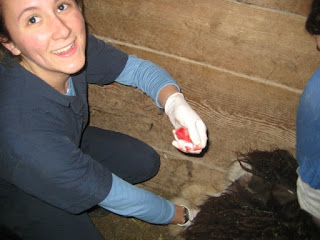
A few weeks ago, this email appeared in my inbox:
Seeing as how I have zero experience working with llamas, naturally, I signed up.
It turned out that most of the llamas were geldings, so we knew ahead of time that we probably weren't going to be doing any preg checks, but that was just about all we knew going into the day. When we arrived at the farm, the owner showed us around, and then explained his plan: one by one, send each llama into a squeeze chute, vaccinate it, scan it for a microchip (just like the ones to reunite lost pets with their owners), and take its photo for his website.
A low hum, similar to the sound made by a swarm of angry hornets, filled the barn: twenty vet students, who had just driven 2 and a half hours to get some hands-on llama wrangling experience, did the math, and immediately figured that 3 vaccines, a photo, and scanning for a microchip meant approximately 5 people would be occupied at any given moment, while the rest of us stood around and watched.
A few tentative hands went up, and with them, a few tactful inquiries were made.
"Dr. Smith, is there anything we can do with the llamas while they are still in the pen, before they go to the chute?"
"It seems like putting each llama through the chute might take a very long time."
"Maybe we can put the first one in the chute, just to demonstrate everything we're going to be doing."
After the first llama was secured in the chute, vaccinated, scanned, and photographed, the farm owner had a brilliant idea: "Maybe," he mused aloud, "if the students work in teams....they'll be able to do the vaccines in the pens, and we'll use the chute just for photos and microchip scanning."
So, that is what we did. There was a big open pen toward the back of the barn, and four or five smaller pens or stalls near the front. Other volunteers (local llama enthusiasts) sent groups of llamas out of the big pen, and we herded them into the stalls. Then we got to work. A pair of students started drawing up vaccines, and I joined up with some of my friends to start wrestling llamas.
It was harder than we suspected. Llamas are not huge creatures, not compared to horses and dairy cows, but they are strong. They fling their necks around, rear up, and strike with their hind legs. They are also agile--on more than one occasion, a llama, standing at the gate to a pen that was at least at their eye-level, would get the notion that life outside the pen looked a lot more promising than life inside the pen, where it's brethren were systematically being chased around, poked, and prodded. So it would do what any llama would do: take a deep breath, and attempt to jump straight up and over the gate. Many were successful; including one that jumped over the gate I was guarding to prevent just such an occurrence.
Two of the vaccines we were giving could go right into the muscle; but the third had to go subcutaneously--under the skin. The llamas' extensive fleeces, and thick, tight skin make sub-Q injections a challenge at best. Luckily, whoever designed the llama gave it a bare patch of skin, right in its armpit, just perfect for giving injections. You still have to move the fleece out of the way to find that little bare patch, and you still have to get that needle through the tough skin, but it's a heck of a lot easier than trying anywhere else.
After about two solid hours of vaccinating, we seemed to be about half way through, and took a break to eat lunch. The owner provided us with pizza, and lots of desserts, including several different kinds of brownies and cookies, and chocolate cupcakes. Someone must have informed him that vet students will do just about any task if there's a free meal involved. After lunch, everyone was re-energized, and the second half of the llamas were vaccinated in what seemed like half the time it took to do the first half. Then, the real fun began!
Although the llamas were supposed to have all been females or geldings, we ended up with six that were intact males. (Did I mention that one of our tasks was to cop a feel of every llama we vaccinated to determine that exact fact?) Six times two is twelve; twelve students would have the chance to perform half of the castration procedure. After watching the first one, and calculating the odds that they would actually get to do the procedure, and realizing what time it would be when they arrived back at school, a couple of carloads of students left, vastly increasing the chance that I, myself, would get to castrate a llama. Once Dr. Sprout had guided students through the first 2 llamas, she said, "You guys get the drill now, right? Can you take it from here?" And we did. Those who had already gone coached the ones who hadn't, and those who were waiting held tails out of the way, sat on unruly llamas, passed instruments, or documented each other's achievement of another vet school milestone: First Surgury on a Llama. First Surgury Without a Clinician Watching. First Surgury in the Field. For most of us, First Surgury would suffice.

Monday, February 21, 2011
On a Northern Spring.
Spring is definitely coming: a statement of the obvious? Perhaps; the earth is still orbiting the sun, last time I checked. Scientifically, spring is inevitable. But obvious? Not around here. I cleared 6 inches of snow off my car this morning and the thermometer is currently reading 14 degrees Fahrenheit. If you are looking for storybook, fairytale, Disney signs of spring, you won't find them. If, however, you dig a little deeper and read between the lines, so to speak, it's apparent: winter's vise grip has been loosened.
When I brush Badger these days, little clouds of hair come up with every pass of the brush. Shedding season has arrived! It's not much to start with, but in another week or two, I'll no longer be able to run to the grocery store straight from the barn...at least not without a measure of embarrassment for the extra coat of fur I've acquired. Two weeks ago, we had a day that was sunny, and quite breezy, and really not all that warm (probably around 35°F). There was just a quality to the air that felt different, gentler, maybe with a breath of humidity, reflecting the rainy spring days to come. Then, last Thursday and Friday, we had a real taste: two sunny, melty, balmy days in a row! On Thursday, someone spotted a turkey vulture--I hadn't realized they went elsewhere for the winter, but the man said it was the first one of the season, Friday I believe it even hit 60°F. The ice on the creek broke up, and Milo and I went to look at the ice jams--a sure sign of spring.
Naturally, around here, weather like that doesn't gain a sure foothold until well into May, and we had 6 inches of snow on Saturday and Sunday in addition to the 6 that fell last night. They are predicting single digits for the low tonight, and sub-zero temps for tomorrow night. But Spring has gained the upper hand--I saw a pair of bluebirds yesterday.
At the beginning of the semester, I encountered a piece of Percy Bysshe Shelley verse that perfectly portrays the mindset necessary for surviving a Northern winter:
When I brush Badger these days, little clouds of hair come up with every pass of the brush. Shedding season has arrived! It's not much to start with, but in another week or two, I'll no longer be able to run to the grocery store straight from the barn...at least not without a measure of embarrassment for the extra coat of fur I've acquired. Two weeks ago, we had a day that was sunny, and quite breezy, and really not all that warm (probably around 35°F). There was just a quality to the air that felt different, gentler, maybe with a breath of humidity, reflecting the rainy spring days to come. Then, last Thursday and Friday, we had a real taste: two sunny, melty, balmy days in a row! On Thursday, someone spotted a turkey vulture--I hadn't realized they went elsewhere for the winter, but the man said it was the first one of the season, Friday I believe it even hit 60°F. The ice on the creek broke up, and Milo and I went to look at the ice jams--a sure sign of spring.
Naturally, around here, weather like that doesn't gain a sure foothold until well into May, and we had 6 inches of snow on Saturday and Sunday in addition to the 6 that fell last night. They are predicting single digits for the low tonight, and sub-zero temps for tomorrow night. But Spring has gained the upper hand--I saw a pair of bluebirds yesterday.
At the beginning of the semester, I encountered a piece of Percy Bysshe Shelley verse that perfectly portrays the mindset necessary for surviving a Northern winter:
If Winter comes, can Spring be far behind?The answer is, soundly, No.
Sunday, February 20, 2011
Block 4 re-cap, or why I haven't posted anything in 4 months.
It's hard to know what to say about an experience like Block 4. Even more so than Block 1, the first, ten-week anatomy course, Block 4 felt like what hazing must be like, except that I think there is supposed to be at least a superficial element of fun in hazing. I wish I had written during the block, because now, looking back, it's all blurry and vague, like when you wake up from a bad dream with only the sense of unrest to tell you you've had a nightmare. Reading what I've just written, I realize how dramatic and exaggerated it sounds. But really, there's nothing funny about memorizing all the bacteria, viruses, fungi, and parasites that can infect dogs, cats, horses, cows and chickens.
Some highlights:
I was color coding my flashcards depending on whether they were bacteria, viruses, fungi, or parasites. I used up my green "bacteria pen." Twice.
One of our labs involved running an ELISA (a test that can detect antibodies) on serum from our own animals, to determine if they were allergic to anything. I got to draw blood from my own dog, which was pretty cool.
Pathogen Bowl: Supposed to make learning pathogens fun, what it actually did was force us all to watch one person with a photographic memory answer every question almost before it was finished being asked. Not fun.
The cells of the immune system make great Halloween costumes: meet the Sexy B-Cell.


Some highlights:
I was color coding my flashcards depending on whether they were bacteria, viruses, fungi, or parasites. I used up my green "bacteria pen." Twice.
One of our labs involved running an ELISA (a test that can detect antibodies) on serum from our own animals, to determine if they were allergic to anything. I got to draw blood from my own dog, which was pretty cool.
Pathogen Bowl: Supposed to make learning pathogens fun, what it actually did was force us all to watch one person with a photographic memory answer every question almost before it was finished being asked. Not fun.
The cells of the immune system make great Halloween costumes: meet the Sexy B-Cell.

Puppy pile: the best way to de-stress from Block 4.

So, with Block 4 safely out of the way and successfully repressed in my memory, I hope to write more this semester!
Wednesday, October 20, 2010
How to be a scientist
These words came out of my mouth in class last Friday: "Use your imagination and have a little faith...that's what science is all about!"
My original intent was quite literal, and it was only upon hearing the words outloud as I spoke them that they sounded funny and ironic. So often, we use science to trump imagination and faith, but you really can't do science without imagination and faith! Science has hard facts, science has proof, science always tells the truth...but there would be no elegant experiments without imagination, and many a researcher has succeeded only because they had faith in their science when others didn't.
Medicine, too, benefits from imagination and faith. When confronted with a list of signs and symptoms, it often takes some imagination to figure out how they fit together. Medicine is not all miraculous cures and grateful patients, either, and a little faith that in the end, it does matter that one is a doctor, can make the daily grind more bearable.
Finally, education. What use are imagination and faith in education, especially education at the professional level? I often qualify my level of comprehension with the words, "I can imagine how X would interact with Y to produce effect Z." I mean that I am not confident X and Y do interact, but based on the knowledge I am confident in, effect Z would follow logically, if, indeed X and Y interact. Faith's role is in saying outloud what it is I imagine. I have faith in some prorportion of my knowledge on any given topic, I have faith that my logic is correct, I have faith that even if I am wrong next time, in the future I may be right, and, most importantly, I have faith that saying something that is wrong outloud is okay.
Many of my peers seem reluctant to hazard guesses when asked questions that probe the outermost extent of our current knowledge. I don't know if it's because they don't use their imaginations to arrive at a possible answer, or if they don't have faith that guessing wrong is okay. I'm sure in some cases, it's both.
My original intent was quite literal, and it was only upon hearing the words outloud as I spoke them that they sounded funny and ironic. So often, we use science to trump imagination and faith, but you really can't do science without imagination and faith! Science has hard facts, science has proof, science always tells the truth...but there would be no elegant experiments without imagination, and many a researcher has succeeded only because they had faith in their science when others didn't.
Medicine, too, benefits from imagination and faith. When confronted with a list of signs and symptoms, it often takes some imagination to figure out how they fit together. Medicine is not all miraculous cures and grateful patients, either, and a little faith that in the end, it does matter that one is a doctor, can make the daily grind more bearable.
Finally, education. What use are imagination and faith in education, especially education at the professional level? I often qualify my level of comprehension with the words, "I can imagine how X would interact with Y to produce effect Z." I mean that I am not confident X and Y do interact, but based on the knowledge I am confident in, effect Z would follow logically, if, indeed X and Y interact. Faith's role is in saying outloud what it is I imagine. I have faith in some prorportion of my knowledge on any given topic, I have faith that my logic is correct, I have faith that even if I am wrong next time, in the future I may be right, and, most importantly, I have faith that saying something that is wrong outloud is okay.
Many of my peers seem reluctant to hazard guesses when asked questions that probe the outermost extent of our current knowledge. I don't know if it's because they don't use their imaginations to arrive at a possible answer, or if they don't have faith that guessing wrong is okay. I'm sure in some cases, it's both.
Tuesday, October 5, 2010
Hit with the Knowledge Train
Last week we started our course on immunology, bacteriology, mycology, virology, and parasitology. Here's a sampling:
Major histocompatibility complex, mannose-binding lectin, C3 convertase, cathelicidins, bactericidal permability increasing protein, clonal expansion, transmigration, extravasation, diapedesis, intracellular adhesion molecules, sialyl-Lewis moiety, polymorphonuclear cells, interleukin, interferon, NF-kappa-B, Toll-like receptors, Nod-like receptors, RIG-1 -like receptors, pentraxins, collectins, rationally attenuated pathogens, multivalent vaccines, variolation, anamnestic response.
Teichoic acid, peptidoglycan, lipopolysaccharide, Mannheimia haemolytica, Pasteurella multocida, Haemophilus, Histophilus, progressive atrophic rhinitis, shipping fever, infectious coryza, Streptococcus, Rhodococcus, Bordetella, strangles.
Macroconidia, blastoconidia, basidiomycetes, Aspergillus, Cryptococcus, Blastomyces, Dermatophytoses.
Virion, capside, peplomer, serotype, Herpesvirus, Parvovirus, dimer duplex DNA, psuedorabies, malignant catarrhal fever of cattle, latency, patency, vertical transmission.
Culex anopheles, Lutzomyia, Leishmania, Bartonella bacilliformis, Stomaxys calcitrans, Haematobia irritans, Glossina morsitans, Melophagus, Hippobosca, Lipotena cervi, Wohlfahrtia vigil, Calliphora, Lucilia cuprina, Cochliomyia hominivorax, Gasterophilus, Cuterebra, Anoplura, Mallophagus, Linognathus, Siphonaptera, Felicola subrostratus, Heterodoxus spinager, Panstrongylus.
Don't forget Poisonous Plants: Zea, Avena, Saponaria, Quercus, Acer, Prunus, Malus, Veratrum, Equisetum, Podophyllum, Toxicodendron.
I think there may be flashcards in my future...
Major histocompatibility complex, mannose-binding lectin, C3 convertase, cathelicidins, bactericidal permability increasing protein, clonal expansion, transmigration, extravasation, diapedesis, intracellular adhesion molecules, sialyl-Lewis moiety, polymorphonuclear cells, interleukin, interferon, NF-kappa-B, Toll-like receptors, Nod-like receptors, RIG-1 -like receptors, pentraxins, collectins, rationally attenuated pathogens, multivalent vaccines, variolation, anamnestic response.
Teichoic acid, peptidoglycan, lipopolysaccharide, Mannheimia haemolytica, Pasteurella multocida, Haemophilus, Histophilus, progressive atrophic rhinitis, shipping fever, infectious coryza, Streptococcus, Rhodococcus, Bordetella, strangles.
Macroconidia, blastoconidia, basidiomycetes, Aspergillus, Cryptococcus, Blastomyces, Dermatophytoses.
Virion, capside, peplomer, serotype, Herpesvirus, Parvovirus, dimer duplex DNA, psuedorabies, malignant catarrhal fever of cattle, latency, patency, vertical transmission.
Culex anopheles, Lutzomyia, Leishmania, Bartonella bacilliformis, Stomaxys calcitrans, Haematobia irritans, Glossina morsitans, Melophagus, Hippobosca, Lipotena cervi, Wohlfahrtia vigil, Calliphora, Lucilia cuprina, Cochliomyia hominivorax, Gasterophilus, Cuterebra, Anoplura, Mallophagus, Linognathus, Siphonaptera, Felicola subrostratus, Heterodoxus spinager, Panstrongylus.
Don't forget Poisonous Plants: Zea, Avena, Saponaria, Quercus, Acer, Prunus, Malus, Veratrum, Equisetum, Podophyllum, Toxicodendron.
I think there may be flashcards in my future...
Learning styles
As I've mentioned before, physiology is a flowchart-heavy subject, which I love, because drawing a picture of something helps me remember it. That I prefer to think and learn visually has never been more apparent than in this course. When I sit down to read Duke's Physiology of Domestic Animals, my textbook of choice, I find my eyes jumping immediately to the diagrams and images whenever I turn the page. Interestingly, Duke's is has neither the prettiest nor the most figures and tables. There's not a single color image in the whole text, and rarely do the diagrams take up more than half a page. Boron & Boulpaep's Medical Physiology is chock full of full-color, full-page diagrams, but they are often so complex that they cannot stand alone; sometimes, the caption isn't even enough, and to get anything from the graphic, you have to jump back and forth between the text and the graphic it references. If you get lucky, the graphic is on the same page as its reference! The graphics in Duke's, rudimentary as they may be, are the embodiment of the old proverb, "A picture is worth a thousand words."
When we're going over a case in tutor group, my contributions to the conversation are often accompanied by gestures I don't even realize I'm making until I catch a glimpse of my groupmates' amused faces. I often cannot articulate an idea or a concept until I am at the whiteboard, drawing a picture of it. At the very least, my statements do not make any sense without the image in my head I'm using to make them. One of my other group members is as strong a verbal learner as I am visual–she was answering a question I had asked, and her answer was well-phrased and articulate, and, as I said to her, I understood all of her words, but I just couldn't picture what she meant. I asked her to draw it and explain it again, and of course, it was plain as day. I like having both of us in the group, because with all the translating back and forth between pictures and words, I think it makes the whole group's experience that much richer.
Although I do believe my preferred learning style is visual, I've come to realize only recently (as in, less than 24 hours ago) that deep, global comprehension comes more from the translation between formats than from re-creating something in the same format. I need to read about a topic, transform what I've read into a flow chart, graph, or other diagram, and then write a narrative in my own words, explaining what I've drawn. Though I wish I had realized it sooner than the weekend before the final, I'm thrilled with my new understanding of myself and how I learn, and I can't wait to apply it from the very beginning of our next course.
Allow me to make a very clunky transition here to another educational concept: failure-based learning. The following excerpt is from an article in the New York Times Magazine titled "Learning by Playing: Video Games in the Classroom."
When we're going over a case in tutor group, my contributions to the conversation are often accompanied by gestures I don't even realize I'm making until I catch a glimpse of my groupmates' amused faces. I often cannot articulate an idea or a concept until I am at the whiteboard, drawing a picture of it. At the very least, my statements do not make any sense without the image in my head I'm using to make them. One of my other group members is as strong a verbal learner as I am visual–she was answering a question I had asked, and her answer was well-phrased and articulate, and, as I said to her, I understood all of her words, but I just couldn't picture what she meant. I asked her to draw it and explain it again, and of course, it was plain as day. I like having both of us in the group, because with all the translating back and forth between pictures and words, I think it makes the whole group's experience that much richer.
Although I do believe my preferred learning style is visual, I've come to realize only recently (as in, less than 24 hours ago) that deep, global comprehension comes more from the translation between formats than from re-creating something in the same format. I need to read about a topic, transform what I've read into a flow chart, graph, or other diagram, and then write a narrative in my own words, explaining what I've drawn. Though I wish I had realized it sooner than the weekend before the final, I'm thrilled with my new understanding of myself and how I learn, and I can't wait to apply it from the very beginning of our next course.
Allow me to make a very clunky transition here to another educational concept: failure-based learning. The following excerpt is from an article in the New York Times Magazine titled "Learning by Playing: Video Games in the Classroom."
The language of gamers is, when you begin to decipher it, the language of strivers. People who play video games speak enthusiastically about “leveling up” and are always shooting for the epic win. Getting to the end of even a supposedly simple video game can take 15 or more hours of play time, and it almost always involves failure — lots and lots of failure.
This concept is something that Will Wright, who is best known for designing the Sims game franchise and the 2008 evolution-related game Spore, refers to as “failure-based learning,” in which failure is brief, surmountable, often exciting and therefore not scary. A well-built game is, in essence, a series of short-term feedback loops, delivering assessment in small, frequent doses. This in the end may be both more palatable and also more instructive to someone trying to learn. According to Ntiedo Etuk, the chief executive of Tabula Digita, which designs computer games that are now being used in roughly 1,200 schools around the country, children who persist in playing a game are demonstrating a valuable educational ideal. “They play for five minutes and they lose,” he says. “They play for 10 minutes and they lose. They’ll go back and do it a hundred times. They’ll fail until they win.” He adds: “Failure in an academic environment is depressing. Failure in a video game is pleasant. It’s completely aspirational.”
It is also, says James Paul Gee, antithetical to the governing reality of today’s public schools. “If you think about kids in school — especially in our testing regime — both the teacher and the student think that failure will lead to disaster,” he says. “That’s pretty much a guarantee that you’ll never get to truly deep learning.” Gee and others in the games-and-learning field have suggested that someday, if we choose to channel our resources into developing more and better games for use in classrooms, the games themselves could feasibly replace tests altogether. Students, by virtue of making it through the escalating levels of a game that teaches, say, the principles of quantum physics, will demonstrate their mastery simply by finishing the game. Or, as Gee says: “Think about it: if I make it through every level of Halo, do you really need to give me a test to see if I know everything it takes to get through every level of Halo?”
Hmm. What a fascinating concept! Failure as "...brief, surmountable, often exciting, and therefore not scary..." It's absolutely true. I've played enough video games to know that the desire to try again is never stronger than immediately after failing. Is it the knowledge that the world in which the failure occurs is a virtual one? Is it that, even within the virtual world, there is no limit to the number of times you are "allowed" to fail before finally succeeding? Think about that–if, ultimately, you succeed, you make it to the end of level 1, say, the game does not come back and say, we're sorry, it took you eleventy-seven tries to finish the level, you are not good enough to keep going. It says, you did it! You get to go to level 2!
I can think of ways to apply that concept even outside a virtual world. In second grade, part of the math curriculum was the Mad Math Minute. Every Monday was the pre-test, whose score didn't count, and every Friday was the Real Mad Math Minute, whose score did count. We worked through addition, subtraction, multiplication, and division with these Math Minutes. You couldn't go to the next level until you successfully completed the first one. Here's how I would change it: rather than having just one pre-test, have as many as the student needed. Allot 10, or even just 5 minutes every day for students to practice, one minute at a time. If they don't finish the level in one minute, they get to start over, but once that 5 minutes is up, they have to put the "game" down until the next day. While not my area of expertise, I can't imagine designing a computer program to those parameters would be beyond a freshman computer science major.
I love a good upheaval of the conventional wisdom!
I love a good upheaval of the conventional wisdom!
Tuesday, September 14, 2010
Dr. G....veterinary medical examiner?
There's a woman here who is a bit quirky, a bit non-conformist, and a bit intimidating. She's become a legend in her own time. Any student here can easily tell you one or two folktales about the doctor I am now christening Dr. G. (The "real" Dr. G is a medical examiner who has a TV show on Discovery Health. She always gets to the bottom of mysterious deaths.) This quirky, out there vet and professor earned this title last week, after a lecture she gave, in which she, too, got to the bottom of some mysterious deaths. In this case, the victims were pigs who were living in their owner's backyard. Dr. G was called to the farm when the first pig died. It was sent to necropsy, but the results, while inconclusive, hinted to Dr. G that some sort of toxin might be involved. She's the kind of person who would sit down with every book on toxicities and poisonous plants in the library, and her list of symptoms and findings, and go through page by page until she had generated a new list of every possible cause of death. Dr. G is thorough, to say the least. After many sleepless nights, sneaking into the library under her Invisibility Cloak to steal books from the Restricted Section, writing scroll after scroll.....
Dr. G took her list and returned to the backyard, whereupon she asked the owner one question: "Do you shoot clay pigeons?" The owner replied, "No, but when I moved in here, there were piles of shotgun shells out back."
A close inspection of the backyard did, in fact, turn up some shards of old clay pigeons. The discs' interiors are coated with pitch, which is, apparently, poisonous to pigs when ingested.

Dr. G is also the professor of the Poisonous Plants course, and a small ruminant specialist. She is most often seen dressed in cargo shorts, with her T-shirt tucked in, wearing Birkenstocks or Tevas with socks. Her favorite sport is orienteering. If I had to survive in the wilderness, I would want Dr. G by my side.
There are many more stories about Dr. G (and I'm sure I will acquire new ones) for future sharing.
Dr. G took her list and returned to the backyard, whereupon she asked the owner one question: "Do you shoot clay pigeons?" The owner replied, "No, but when I moved in here, there were piles of shotgun shells out back."
A close inspection of the backyard did, in fact, turn up some shards of old clay pigeons. The discs' interiors are coated with pitch, which is, apparently, poisonous to pigs when ingested.

Dr. G is also the professor of the Poisonous Plants course, and a small ruminant specialist. She is most often seen dressed in cargo shorts, with her T-shirt tucked in, wearing Birkenstocks or Tevas with socks. Her favorite sport is orienteering. If I had to survive in the wilderness, I would want Dr. G by my side.
There are many more stories about Dr. G (and I'm sure I will acquire new ones) for future sharing.
Herbology
This semester one of my electives is Poisonous Plants. Sounds like Harry Potter, right? Luckily, though poisonous, none of the plants we're learning about have teeth, or the ability to produce ear-splitting screams. The first two sessions of class involved tromping around campus actually looking at plants, which was great, but the rest of the semester is all lecture based. Either way, I enjoy going out in the woods with my dog, and being able to identify some of the plants we see. I like knowing the names of things, whether it's part of a boat that offers no hint as to its location or purpose (like pintle and gudgeon), or constellations, or birds and plants, I like knowing the answer to the question "What's that?". I imagine I started asking that not long after I started talking, and even if I don't verbalize it everytime it pops in my head, it's often on my mind.
Friday, September 10, 2010
Where's the love?
Unlike the majority of my classmates, whose degrees are in animal science, my undergraduate degree is in biology. This leads me to say things like, "I love cells!" and, "I miss biochemistry lab..." or "It really is all about electrons, isn't it?" at which point my classmates roll their eyes and shake their heads.
In my mind, medicine is as much a science as biology or chemistry or physics. In fact, just as history, literature, languages, philosophy, and art can be collectively studied as the humanities, medicine is truly the collective study of biology, chemistry, physics, psychology, and, I would argue, art and language as well.
Our curriculum begins with the study of anatomy, a subject which is somewhat set apart from the rest. It is both a foundation and a culmination. The organism must operate within the boundaries of its anatomy, but, as they say, form follows function. Since returning from spring break, we have embarked upon our study of physiology, the functions that follow said form.
I love physiology. We talked current and resistance, concepts I first encountered in physics, when we were learning cardiovascular physiology. We talked mass action, one of the most important concepts in chemistry, when we were learning acid-base disturbances as well as endocrine physiology. I love making those connections and seeing how what we're learning fits into the larger context of what I have already learned through my biology curriculum, but I often feel like the only person who sees those connections.
Those connections are the whole point. I am not in school to learn to be a doctor. I am in school to acquire (or at least to begin to acquire) the body of knowledge that is medicine, which will allow me to be a doctor.
In my mind, medicine is as much a science as biology or chemistry or physics. In fact, just as history, literature, languages, philosophy, and art can be collectively studied as the humanities, medicine is truly the collective study of biology, chemistry, physics, psychology, and, I would argue, art and language as well.
Our curriculum begins with the study of anatomy, a subject which is somewhat set apart from the rest. It is both a foundation and a culmination. The organism must operate within the boundaries of its anatomy, but, as they say, form follows function. Since returning from spring break, we have embarked upon our study of physiology, the functions that follow said form.
I love physiology. We talked current and resistance, concepts I first encountered in physics, when we were learning cardiovascular physiology. We talked mass action, one of the most important concepts in chemistry, when we were learning acid-base disturbances as well as endocrine physiology. I love making those connections and seeing how what we're learning fits into the larger context of what I have already learned through my biology curriculum, but I often feel like the only person who sees those connections.
Those connections are the whole point. I am not in school to learn to be a doctor. I am in school to acquire (or at least to begin to acquire) the body of knowledge that is medicine, which will allow me to be a doctor.
Defining the "job" of a professor
Interesting conversation on our way to school this morning. Friday means neuroanatomy, and neuroanatomy means 2 hours of lecture followed immediately by 2 hours of lab. Who is the lovely soul who gets to preside over the entire class of first years for 4 consecutive hours? Let's call her Pia Mater. No one would envy her her task...neuroanatomy is a notoriously difficult course, and P. Mater has exactly 28 hours of lecture and lab to build us a foundation that will support our future endeavors in the neurology course and clinical rotation. The conversation this morning stemmed from an interaction, via email, that one of my housemates had with P. Mater. Housemate had emailed P. Mater with a question, which P. Mater had answered with the suggestion to investigate some further sources. Housemate contended that P. Mater was shirking responsibility to reply as she did, and this is what sparked our conversation. Are we, as students paying tuition, customers? Do we employ our professors? I cannot subscribe to this mindset. I believe we pay tuition for the privilege of studying under and learning from the professors employed by a college. Learning is not meant to be passive. It is not the "job" of a professor to ensure her students' success, especially at the graduate and professional level. This gets right back to my belief that as vet students, we are truly students first. To matriculate in this program is to have some love of learning for learning's sake. If you don't enjoy the pursuit, it's going to be a long four years. Learning how to learn is equally important for this career. Not every case fits neatly into the flow charts and dichotomous keys of Ettinger's Veterinary Internal Medicine. Practicing the skills that allow us to dig up information when we're not even quite sure what we're looking for, or where to look for it, is an investment that will pay dividends down the road. This was one of those conversations where my reaction was in the form of a very strong conviction, which, at the time, I had a very hard time articulating.
Sunday, June 6, 2010
1200 Vet Students in One City

That's ten percent of all the vet students in North America!
The University of Wisconsin graciously hosted the 2010 SAVMA Symposium. (That's the Student American Veterinary Medical Association.) It was four days of lectures, wet labs, field trips, athletic and academic competitions, SWAG, and, of course, socializing. I attended a lecture on Large Animal Fluid Management in the Field, a panel discussion with three dairy producers about What Producers Expect from their Veterinarians, went on a field trip to four dairy farms just outside Madison, and explored downtown Madison.
Next year's symposium is at U.C. Davis!
Video killed the radio star...
...but Powerpoint killed the academic lecture.
Most of our lecturers are mediocre. A handful are heinous; only a few have truly mastered the art of engaging an audience with the spoken word. It's no wonder, really, because when in the course of an academic career does one receive the training to do so? Perhaps high school, perhaps the dreaded Public Speaking 101 in college. The curriculum design committees have done their level best to ensure we are lectured to by the best and brightest in their fields--but these people have achieved their status by writing excellent grant proposals and excellent journal articles. Sure, they may present research at conferences, but no one's going to take away their funding for putting the audience to sleep. For one thing, no one's testing the audience on the material later, and for another, the audience can always consult the original article for more information.
I think, though, that Powerpoint subtracts from rather than enhances most lectures. I've had enough powerpoint presentations to create for various classes, I know how difficult a medium it is to control. It is SO easy to think that pretty slides are useful, or that any bulleted list is automatically an organized list, or that just because you have a cool animated transition between slides, a real, logical transition between topics occurred. It allows lecturers to remove the organization of their lecture from their mind, put it on what amounts to a stack of cards, and thereby completely detach themselves from the process and progress of the lecture.
Powerpoint also disengages the audience from the presenter and presentation. Powerpoint enables instructors to cram more information into one lecture. The audience (that's us, the students!) are taking notes and wish to review at a later date the information in the presentation! I cannot write as fast as someone speaks. I don't mean that students should write every word down, either. But when lecturers write on an overhead or chalkboard, students have more time to make our notes coherent. And whatever has been written or diagrammed stays there while the lecturer speaks about it, even after they've moved on, unlike the information on a powerpoint slide that is there for 30 seconds and then replaced by the next slide. I promise you, a room of students who are bent on copying every word on the slide before it disappears are not reading any of those words, or listening to any of the words being spoken by the lecturer. The solution offered to this problem is to supply the class with a printed copy of the powerpoint slides, but this further disengages the audience. What's the point of listening, if all the information is already in my hand?
The result is a vicious cycle. Powerpoint lectures are difficult lectures to learn anything from, because we students simply can't write fast enough. If, on an exam, a question refers to something not written in the notes, the students revolt. Professors then attempt to cram every word into their powerpoint slides, rendering them even less useful during the lecture, while students drowse and daydream during the lecture, because everything that might be on the exam is written on the powerpoint slides they have printed out in front of them, so why listen?
Most of our lecturers are mediocre. A handful are heinous; only a few have truly mastered the art of engaging an audience with the spoken word. It's no wonder, really, because when in the course of an academic career does one receive the training to do so? Perhaps high school, perhaps the dreaded Public Speaking 101 in college. The curriculum design committees have done their level best to ensure we are lectured to by the best and brightest in their fields--but these people have achieved their status by writing excellent grant proposals and excellent journal articles. Sure, they may present research at conferences, but no one's going to take away their funding for putting the audience to sleep. For one thing, no one's testing the audience on the material later, and for another, the audience can always consult the original article for more information.
I think, though, that Powerpoint subtracts from rather than enhances most lectures. I've had enough powerpoint presentations to create for various classes, I know how difficult a medium it is to control. It is SO easy to think that pretty slides are useful, or that any bulleted list is automatically an organized list, or that just because you have a cool animated transition between slides, a real, logical transition between topics occurred. It allows lecturers to remove the organization of their lecture from their mind, put it on what amounts to a stack of cards, and thereby completely detach themselves from the process and progress of the lecture.
Powerpoint also disengages the audience from the presenter and presentation. Powerpoint enables instructors to cram more information into one lecture. The audience (that's us, the students!) are taking notes and wish to review at a later date the information in the presentation! I cannot write as fast as someone speaks. I don't mean that students should write every word down, either. But when lecturers write on an overhead or chalkboard, students have more time to make our notes coherent. And whatever has been written or diagrammed stays there while the lecturer speaks about it, even after they've moved on, unlike the information on a powerpoint slide that is there for 30 seconds and then replaced by the next slide. I promise you, a room of students who are bent on copying every word on the slide before it disappears are not reading any of those words, or listening to any of the words being spoken by the lecturer. The solution offered to this problem is to supply the class with a printed copy of the powerpoint slides, but this further disengages the audience. What's the point of listening, if all the information is already in my hand?
The result is a vicious cycle. Powerpoint lectures are difficult lectures to learn anything from, because we students simply can't write fast enough. If, on an exam, a question refers to something not written in the notes, the students revolt. Professors then attempt to cram every word into their powerpoint slides, rendering them even less useful during the lecture, while students drowse and daydream during the lecture, because everything that might be on the exam is written on the powerpoint slides they have printed out in front of them, so why listen?
Thursday, April 22, 2010
Career-Affirming Moments
On Tuesday, we had a lab about hematology. We made blood smears, did differential white cell counts, determined total protein, and generally had a good time pretending to be real doctors. (And by "real doctors" I mean people who have graduated from veterinary school.)
There are five major classes of white blood cells that circulate in health individuals: neutrophils are the most numerous, followed by lymphocytes, monocytes, eosinophils, and basophils. Eosinophils are fairly rare, but you can usually find one if you're patient. Basophils, on the other hand, are much rarer, and the pathologist teaching our lab told us not to even bother looking for one because we probably won't find one. This line is not unfamiliar, and I have spent wasted enough time looking for basophils (by "enough time" I mean probably 10 minutes out of the entire 45 minutes of my life that I have probably spent looking at blood smears) that the thrill of the hunt is completely stale. Other people have seen them, I believe in their existence, and that's good enough for me. To thrive survive in the world of science takes a little faith, sometimes.
And sometimes, science rewards that faith. Like on Tuesday, when I, Jane Herriot, was blessed with the presence, in high-power field number eleventy-something, of what was confirmed to be, really and truly, an equine basophil. I was driving the microscope and my friend C— was sitting across from me looking at the slide through the second set of eye pieces (double-headed scopes rock!) and tallying cells. We were about half way through the differential white cell count. We finished counting the field we were viewing and I moved methodically to the next one. My eyes were met with this:

C— and I looked at each other, the look that says, Are you seeing what I'm seeing? We called the professor over, and she confirmed our find! It was a great day for science.
The real career-affirming moment came today, though. We were sitting in the computer lab working through guided coagulation case studies, when the person sitting across from me mentioned having seen a basophil in hematology lab. "I saw one, too," I said. Person-sitting-across-from-me's lab partner looked at me in awe and said, "Can I touch your hand?!?"
You know medicine is for you when your classmates think you're a hero for finding a basophil on a blood smear.
There are five major classes of white blood cells that circulate in health individuals: neutrophils are the most numerous, followed by lymphocytes, monocytes, eosinophils, and basophils. Eosinophils are fairly rare, but you can usually find one if you're patient. Basophils, on the other hand, are much rarer, and the pathologist teaching our lab told us not to even bother looking for one because we probably won't find one. This line is not unfamiliar, and I have spent wasted enough time looking for basophils (by "enough time" I mean probably 10 minutes out of the entire 45 minutes of my life that I have probably spent looking at blood smears) that the thrill of the hunt is completely stale. Other people have seen them, I believe in their existence, and that's good enough for me. To thrive survive in the world of science takes a little faith, sometimes.
And sometimes, science rewards that faith. Like on Tuesday, when I, Jane Herriot, was blessed with the presence, in high-power field number eleventy-something, of what was confirmed to be, really and truly, an equine basophil. I was driving the microscope and my friend C— was sitting across from me looking at the slide through the second set of eye pieces (double-headed scopes rock!) and tallying cells. We were about half way through the differential white cell count. We finished counting the field we were viewing and I moved methodically to the next one. My eyes were met with this:

(from: http://sites.google.com/site/scienceprofonline/PBBasophil.jpg)
C— and I looked at each other, the look that says, Are you seeing what I'm seeing? We called the professor over, and she confirmed our find! It was a great day for science.
The real career-affirming moment came today, though. We were sitting in the computer lab working through guided coagulation case studies, when the person sitting across from me mentioned having seen a basophil in hematology lab. "I saw one, too," I said. Person-sitting-across-from-me's lab partner looked at me in awe and said, "Can I touch your hand?!?"
You know medicine is for you when your classmates think you're a hero for finding a basophil on a blood smear.
Thursday, April 15, 2010
I heart physiology
I'm going to specialize in internal medicine. The most amazing thing is that I never knew how amazing and interesting physiology was until this year. Surgery is easy. Surgeons open their patients up, see what needs fixing, and fix it with sewing kits and Erector sets. Alright, which is pretty cool. But, internists!
Internists are detectives, ferreting out clues to the inner workings of their patients. Their hands pick up subtle differences in the size of lymph nodes. Their ears pick up faint sounds in the lungs. Some of them can even smell metabolic imbalances! In the midst of all the interconnectivity that is homeostasis, they find the soft spot, the organ that's not pulling its weight, the organ that's trying to steal the show. Then, they carefully select a drug from the pharmacy that will set things in order. Willy Wonka would have been an internist.
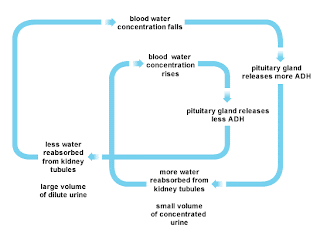
I mentioned interconnectivity, but that was an understatement. No cell in the body does anything on the sly. Right now, I can consider approximately 2 organ systems simultaneously, and it feels a lot like trying to recall one song while the radio in the background plays a different one. To illustrate, the negative feedback pathway for osmoregulation, below, is about the maximum level of complexity that exists in my understanding today.
 (From http://abeautifulwww.com/GeneVisualizations_E01C/roche1_3.jpg)
Close up of N3, showing some steps in the metabolism of glucose.
 (From http://www.expasy.ch/cgi-bin/show_image?N3)
It's no different from learning your way around a new city. At first, you might only know the way between school and home, and then, you might know how to get to the grocery store, but only from home. Eventually, not only can you get everywhere you need to get, but you also know the fastest way from school to the grocery store, whether or not you can stop at the bank or the gas station on your way there, and whether you should stop at the post office before school, on your way to the grocery store, or on your way home at the end of the day.
Eventually, I'm going to have that map in my head!
Physiology is an incredible symphony, isn't it? Our job is to learn to hear each individual instrument and to pick out the melody from the harmonies.
Internists are detectives, ferreting out clues to the inner workings of their patients. Their hands pick up subtle differences in the size of lymph nodes. Their ears pick up faint sounds in the lungs. Some of them can even smell metabolic imbalances! In the midst of all the interconnectivity that is homeostasis, they find the soft spot, the organ that's not pulling its weight, the organ that's trying to steal the show. Then, they carefully select a drug from the pharmacy that will set things in order. Willy Wonka would have been an internist.
I mentioned interconnectivity, but that was an understatement. No cell in the body does anything on the sly. Right now, I can consider approximately 2 organ systems simultaneously, and it feels a lot like trying to recall one song while the radio in the background plays a different one. To illustrate, the negative feedback pathway for osmoregulation, below, is about the maximum level of complexity that exists in my understanding today.

In contrast, the image below is a scientific attempt to characterize all biochemical pathways in one cell.
Close up of N3, showing some steps in the metabolism of glucose.

It's no different from learning your way around a new city. At first, you might only know the way between school and home, and then, you might know how to get to the grocery store, but only from home. Eventually, not only can you get everywhere you need to get, but you also know the fastest way from school to the grocery store, whether or not you can stop at the bank or the gas station on your way there, and whether you should stop at the post office before school, on your way to the grocery store, or on your way home at the end of the day.
Eventually, I'm going to have that map in my head!
Physiology is an incredible symphony, isn't it? Our job is to learn to hear each individual instrument and to pick out the melody from the harmonies.
Sunday, March 7, 2010
It's not tax season, it's financial aid season
What's the difference? Financial aid season is just like tax season, except you have to fill out 3 times the number of forms, answer questions about this year's taxes, last year's taxes, NEXT year's taxes, AND your parents taxes, turn them in a month earlier, and instead of giving you a refund and sending you on your merry way, the government gives you a loan and tells you to keep in touch with Sallie Mae. My parents may not be able to claim me as a dependent anymore, but Sallie Mae sure as heck could....
In addition to the boring financial information, my Institute of Higher Education also collects a personal statement. Theoretically, I know what I want to do when I grow up, because I'm in vet school, right? Wrong. The beauty of vet school is that you don't actually have to decide what you want to be! I've taken to calling it the liberal arts of science and medicine. Amazingly, when I sat down to write my personal statement, the words flowed effortlessly, and I like what I ended up with enough to share it.

In addition to the boring financial information, my Institute of Higher Education also collects a personal statement. Theoretically, I know what I want to do when I grow up, because I'm in vet school, right? Wrong. The beauty of vet school is that you don't actually have to decide what you want to be! I've taken to calling it the liberal arts of science and medicine. Amazingly, when I sat down to write my personal statement, the words flowed effortlessly, and I like what I ended up with enough to share it.
Before I started college, my response to the question "What are you going to be when you grow up?" was, unwaveringly, "An equine vet!" As I made my way through four years of undergraduate study, I realized my interests ranged far and wide. I majored in biology and minored in psychology and chemistry. I especially loved microbiology and immunology, but also truly enjoyed classes I took in political science, art, and American studies. For awhile I wanted to be a vet pathologist, then a behaviorist, then a vet in public health, and then a research scientist. After an internship on a dairy farm, I thought for sure I had found exactly what I wanted to be-a dairy vet! Eventually, I realized that going to vet school would afford me the opportunity to pursue any and all of these interests, and that I wouldn't have to pick just one of the ways of practicing veterinary medicine. That being said, I am still in love with dairy cows, and plan on working with them in some capacity. I could be a rural mixed animal practitioner, a general large animal practitioner, a food production vet, a public health vet, a vet who lobbies Congress on behalf of the dairy industry, a vet who discovers a new treatment for mastitis, or an equine vet who has a hobby dairy farm. More likely, that list wasn't a list of many different career paths, but a list of many stops along one career path. I am not sure what I will do immediately after graduation, but feel quite certain that my career will include research and teaching in addition to clinical practice. In the meantime, I've found plenty to keep me busy outside the lecture hall. I put in a few hours a week working in the pharmacy, and I also work in Dr. Got Milk's lab, feeding and milking the cows in his mastitis research studies. I joined the veterinary fraternity, and am currently serving in the position of alumni chair. I have also just gotten back into riding horses, and look forward to my weekly lesson with the same anticipation I did when I was 6. Maybe I'll be an equine vet after all...

Friday, February 26, 2010
Does time still have to follow those energy and matter rules?
You know, the ones about how neither energy nor matter can be created or destroyed?
It must, because I'm quite positive that in the last 5 weeks, entire days have been AWOL. Really, if 35 calendar days have passed, I would have gotten tons more work done! I'm onto them, though. They're right there in the middle of those lectures that claim to last only an hour by the clock, but that seem to drag on for a week!
It must, because I'm quite positive that in the last 5 weeks, entire days have been AWOL. Really, if 35 calendar days have passed, I would have gotten tons more work done! I'm onto them, though. They're right there in the middle of those lectures that claim to last only an hour by the clock, but that seem to drag on for a week!
Friday, February 19, 2010
Career-Affirming Moments
Every Wednesday morning at 7:30, the large animal medicine department presents a case or two. It happens that Wednesdays are the only day of the week I don't have to be at school by 8 am, but medicine rounds are my favorite, and I needed a better reason than my impending mid-term to get up and at 'em this morning, so there I was. The student on the rotation began presenting the case, a horse with chronic eye problems. This is where it gets good--just last night, we had a dinner lecture about large animal ophthomology cases, so I was hopeful I might have picked up a relevant tidbit or two. I'm going to skip the boring part where I knew the answers to some of the questions the student asked and get to the career-affirming part. (Which is not to say that knowing the answers to questions isn't career-affirming...)
Not only are dry eyes not very functional, but they can also be extremely uncomfortable, so it is imperative that that their normal hydration be restored. If a medical treatment is unavailable, the treatment of choice is a surgery called parotid duct transposition. The parotid gland is one of several salivary glands, and its duct takes a superficial course from the angle of the mandible (corner of the jaw) along the ventral border of the mandible (the lower edge) and then up, to open inside the mouth on the cheek next to the first upper pre-molar. The surgery moves the parotid duct opening from inside the mouth to the outer corner of the eye, replacing the normal tears with saliva. Parotid duct transpositions are actually performed quite frequently in dogs, but the large animal hospital here had only performed two of them on horses, and our case at rounds this morning was the third.
Now, here comes the career-affirming moment: while she was talking to us about possible post-surgical complications, the student fed the horse a carrots. Chomp, chomp, chomp, chomp...another carrot....chomp, chomp, chomp.... And then, a tear welled in the corner of the horse's eye and rolled down his face, followed by another, and another. Of course, the tears we saw were not tears at all, but saliva, showing that, at least initially, the surgery was successful!
As amazing as it was to witness that success as a knowledge-thirsty student, I can only imagine what it must feel like when you know it was your hands that performed that little switcheroo.
Not only are dry eyes not very functional, but they can also be extremely uncomfortable, so it is imperative that that their normal hydration be restored. If a medical treatment is unavailable, the treatment of choice is a surgery called parotid duct transposition. The parotid gland is one of several salivary glands, and its duct takes a superficial course from the angle of the mandible (corner of the jaw) along the ventral border of the mandible (the lower edge) and then up, to open inside the mouth on the cheek next to the first upper pre-molar. The surgery moves the parotid duct opening from inside the mouth to the outer corner of the eye, replacing the normal tears with saliva. Parotid duct transpositions are actually performed quite frequently in dogs, but the large animal hospital here had only performed two of them on horses, and our case at rounds this morning was the third.
Now, here comes the career-affirming moment: while she was talking to us about possible post-surgical complications, the student fed the horse a carrots. Chomp, chomp, chomp, chomp...another carrot....chomp, chomp, chomp.... And then, a tear welled in the corner of the horse's eye and rolled down his face, followed by another, and another. Of course, the tears we saw were not tears at all, but saliva, showing that, at least initially, the surgery was successful!
As amazing as it was to witness that success as a knowledge-thirsty student, I can only imagine what it must feel like when you know it was your hands that performed that little switcheroo.
Subscribe to:
Posts (Atom)

